
Rascal
How I became an expert on raccoons.

In 1964, when I was in eighth grade, three of my cousins took their rifles into the hills for some target practice. They came home with three baby raccoons. One of the teenagers had killed their mother.
The baby raccoons were the size of our cat’s 3-month-old kittens.
Two cousins each took a baby home with them. The third cousin’s mom wasn’t having that animal at her house, so my father brought the baby to ours.
Raccoons in the wild are born in the spring and live with their mothers until the end of winter the following year. The veterinarian estimated that Rascal was about ten weeks old. At that age, raccoon kits are still nursing and being introduced to solid food.
The vet gave us a formula for bottle-feeding with instructions on how to wean Rascal within the next six weeks and a list of appropriate foods to feed her. He gave the raccoon rabies and distemper shots.
Rascal lived in a big dog kennel while Dad and my brother built her an enclosure. They walled off a section of the basement play room. A sleeping platform in a corner was the ceiling of her dining area, a bench with holes for securing Rascal’s water and food bowls.
At the other end of her enclosure was a litter box, which was my brother’s job to keep clean. Dad had gender specific tasks. Boys scooped poop; girls prepared food.
At breakfast, Rascal squatted in front of her bench. She held sliced carrots and apples in her paws and crunched them. She chewed with her mouth open, exposing crushed food in between bites. Puppy kibble from her bowl went into the water basin. She rubbed the nugget back and forth between her paws until it expanded and softened enough to eat.
My brother, Kurt, and his friends teased her with sugar cubes. Her beady black eyes registered surprise as she patted around the water tub for her treasure. She chattered and gave them a pitiful look. They gave her grapes, her favorite treat, as a reward for entertaining them.
Rascal was out of her cage most of the time that Kurt was home. We, girls, were not allowed to be alone with her under the assumption that we wouldn’t be able to wrestle her back into her enclosure without getting hurt.
Raccoons are deceptively cute, evolved to win hearts with their sweet masked faces and their clever little hands. With their sharp toe nails and powerful haunches, however, even babies can inflict deep gashes in tender skin. Coyotes in the wild avoid raccoons. If caught by a predator, the smaller animal rolls onto its back and opens the underbelly of the predator with a powerful kick.
When Rascal was out, she enjoyed grooming the hair of anyone sitting on the couch in the playroom. With her soft, black paws, she padded their head and combed her fingers through their hair. The whole time, she made a chittering sound as if she were telling us about her day.
Sometimes, she sat in my lap with her paws pressed against my cheeks and stared into my eyes. She had upright ears like a teddy bear, a round head, and narrow snout. The gray fur formed a medieval face mask with a strip down her snout and ended at her shiny black nose. Between the white fur on both cheeks and the ring around her nose, her black eyes hid in a patch of black fur. Her paws were cool against my face. I
On the weekends, when the family was in the backyard, Rascal roamed through the garden plots, digging out slugs and grubs to eat. She climbed the fruit trees, helping herself to whatever apples, plums, peaches, or apricots were ripe. She hid in the thick foliage of the grapefruit tree outside my bedroom window. She popped up in different places above the leaves, holding something in her paws, and eating it. I didn’t think about it at the time, but she may have been eating baby birds or eggs from the nests in the tree.
One Sunday afternoon, my parents were sitting on our front porch, listening to the Giants game on the radio. Their big green ashtray—cigarette packs and silver lighters on either side—sat on the railing in front of them, They were drinking 8 oz. cans of Coors.
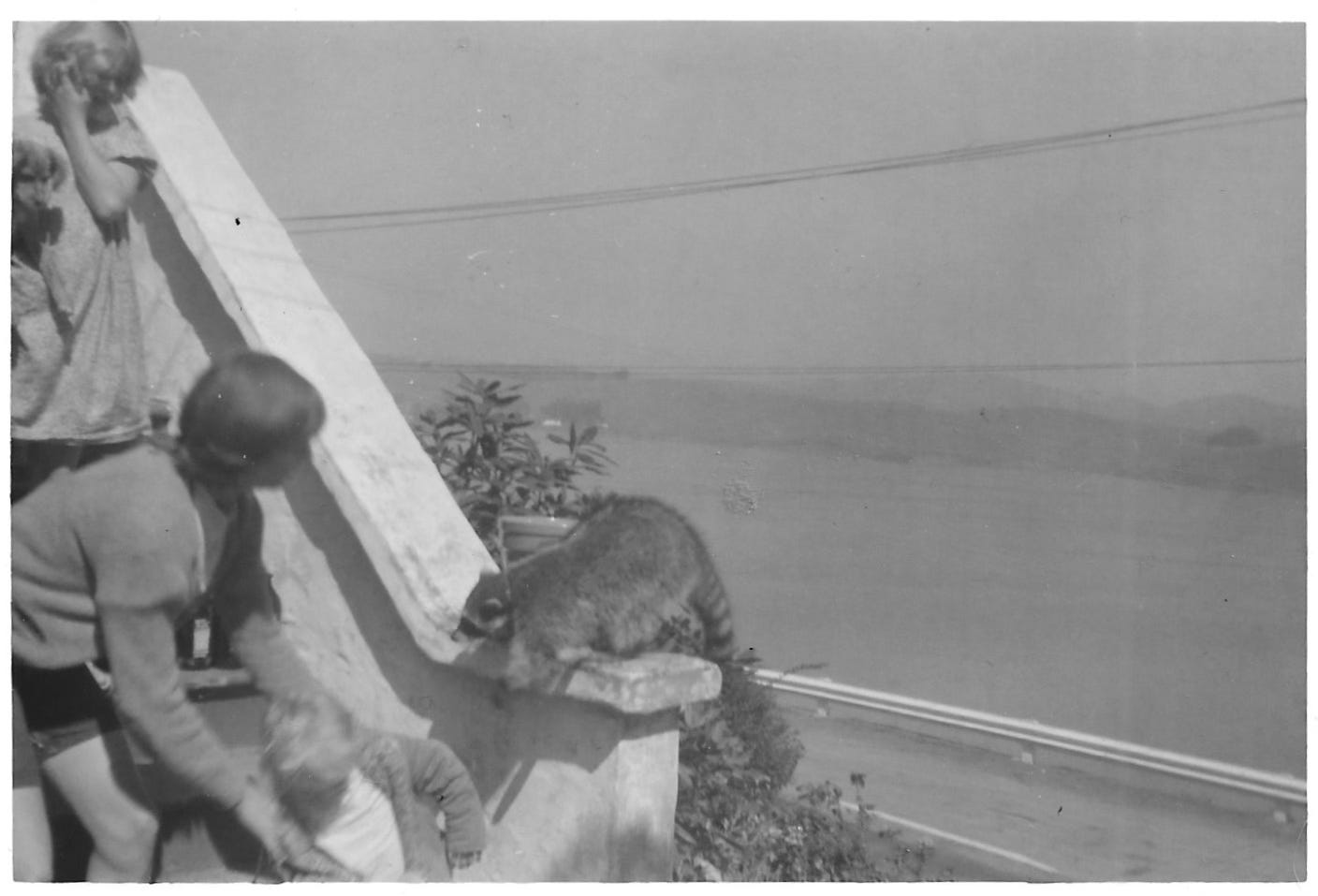
Kurt brought Rascal from the backyard and let her go on the wide banister leading to the porch, so he could take a picture of his three sisters and our pets. I was helping our youngest sister down the front stairs. Our other sister, hugging our cocker spaniel, waited on the riser above me. Rascal reached out to touch Candy’s hair, and the dog, Taffy, barked and snarled struggling to get out of Marcia’s arms. The raccoon hissed and scrambled up the banister to the porch.
Dad put his beer on the banister and opened his arms to her. She crawled up his leg, onto the banister, and snagged the beer can. Out of reach, she leaned against the pillar and lifted the can to her lips. At that moment, a car came around the corner and stopped in front of our house. The driver and a couple of children in the back seat of their station wagon stared out the open windows. The woman passenger got out of the car and walked toward the center of the street.
Shielding her eyes against the sun, she called, “Is that a raccoon drinking beer?
Dad assured the woman that there was no beer in the can that Rascal still held to her lips.
“Raccoons don’t drink alcohol,” he added.
The woman laughed and returned to her car.
***
In 1964, we didn’t see drunken raccoons on television shows like Wild Kingdom, but they must have been out in our towns. YouTube videos have revealed their inability to hold their alcohol.At the end of 2025, a raccoon broke into a liquor store in Virginia. Animal control officers found the bandit sprawled on the bathroom floor near the toilet. According to a local news report, the animal had sampled scotch, whiskey, moonshine, vodka, rum, egg nog, and peanut butter whiskey. The unconscious raccoon was taken to the Hanover County Animal Shelter to sober up and then released into the wild.*
***
One night toward the end of spring, 1965, the sound of metal hitting concrete woke the whole family. Dad ordered us all to stay in bed. I saw him in his pajamas and slippers creep down the stairs. He carried a pistol. I heard him tell my brother to open the basement door and close it as soon as he was inside. The basement door opened and shut.
Another loud crash and Dad yelled for my brother to come downstairs. Mom and I followed him.
Glittering green eyes appeared in the opening above the first landing. We stored odds and ends of stuff we might need one day. As we approached, Rascal pushed a coffee pot onto the stairs and watched it clatter to the cement floor below.
In the center of the playroom, Dad and Kurt faced off.
“How did she get out,” Dad asked.
“I don’t know. I locked the door after I put her inside.
“You must have forgotten,” Dad replied.
Again, Kurt pleaded innocence.
While they checked the enclosure, Mom and I assessed the damage.
Shattered glass jars of last season’s apricot, strawberry, and blackberry jams spilled from the pantry under the stairs and dropped onto the stove below. The canning pots stored on the stove were scattered around the playroom floor. Dad’s workbench had been swept of tools and half-finished woodworking projects. The laundry soap had been knocked off the shelf above the washing machine. The games and toys from the cupboard added to the mess on the floor.
“That’s it,” Mom announced. “She needs to go.”
I didn’t know it at the time, but Rascal had come into heat and had become aggressive toward Kurt. Mom and Dad had discussed taking her to Uncle Bill’s where she could find a mate and build a life for herself.
“We’ll see,” Dad replied. “It won’t happen again.”
He had coaxed Rascal out of her hiding place with frozen grapes and secured her inside the enclosure.
“Kurt left the door unlocked,” Dad continued. “I fixed it, so she can’t escape again.”
The next morning, when Dad came down for breakfast, Rascal was scratching at the basement door.
Over Memorial Day weekend, we brought Rascal up to Uncle Bill’s house in Colfax.
Rascal chittered from her kennel in the back of the station wagon as we drove. We assured her that she would be okay. Uncle Bill would help her get used to being on her own. We were going to leave her kennel in Uncle Bill’s barn where she would be able to explore. She would find some other raccoons. We would come visit.
At Uncle Bill’s, Dad carried Rascal in her kennel to the old goat stall. It was warm and had easy access to the outside. We kids gathered on the railings around the stall while Dad situated the kennel inside.
When he opened the gate, Rascal stepped through the door and patted the straw beneath her. She stood on her hind feet, her paws close to her chest, and inspected her surroundings, glancing first one way through the railings and then the other. Then she climbed onto Dad’s knee, and he lifted her to our level.
He stopped in front of me, and I scratched behind Rascal’s ears and wished her luck. After each of us had said goodbye, Dad put her back into her kennel and left the door ajar.
By the time we finished dinner, Rascal was gone.
Dad said she was probably out exploring. Raccoons are nocturnal, he explained. She might be back in the morning.
She wasn’t. Our cousins helped us search the woods around Uncle Bill’s land, but there was no sign of her.
I never saw her again.
The experience gave me the false impression that I was an expert on raccoons.
I did not meet a suburban raccoon until I moved to Martinez. They are far more clever than an orphan raised by humans. I actually didn’t know raccoons at all.
Raccoons in suburbia is the subject of my next post.
Thank you for reading my essay. I appreciate your feedback and support.
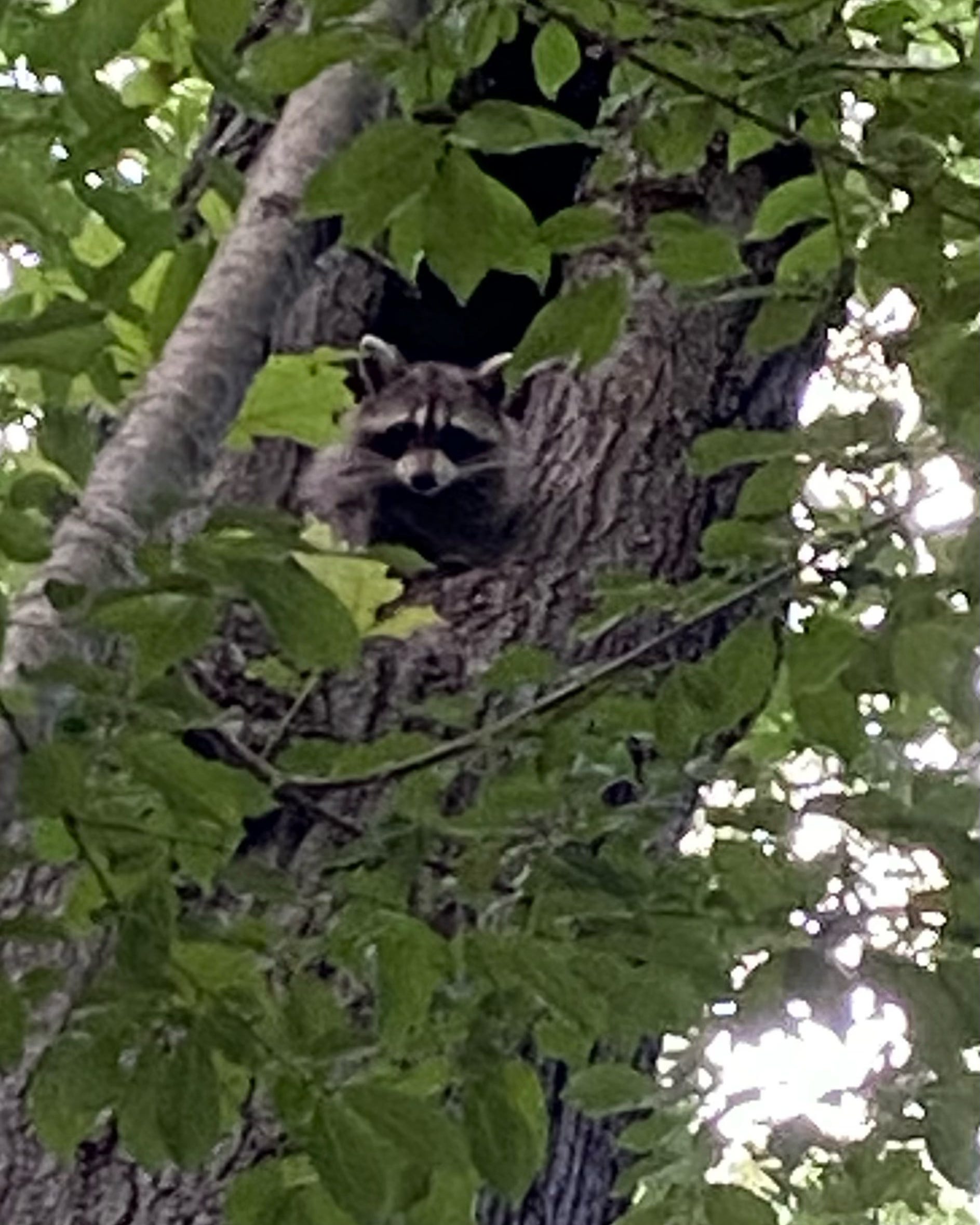
I'll have to tell you about the raccoons that moved into my mother's house in Arkansas. She trapped several, one of which had friends that tried to help it escape. When she and my dad moved out, they took over the entire interior for a while.
I love this story. You brought Rascal to life for us. And I appreciate your father's gender-based division of labor. Lucky for you! 😀